Jennifer Gerwing
I’m the person behind microanalysis commons. You may ask why I would spend hours of my free time developing and maintaining this website. Well, over the past few years, I’ve supervised colleagues who are new to microanalysis, and I keep wishing we had a kind of library- or hub- of relevant, freely available resources. Creating the hub my colleagues could find useful is a way to support them and others to accomplish good work with a little more ease and confidence.
What follows is a personal account of my roots in microanalysis and the motivation behind microanalysis commons. If you’re interested in scholarly stuff, you can find information about my research following these links:
My introduction to face-to-face dialogue
My first class with Janet Bavelas was Psych 340, Interpersonal Communication (January–April 1999).
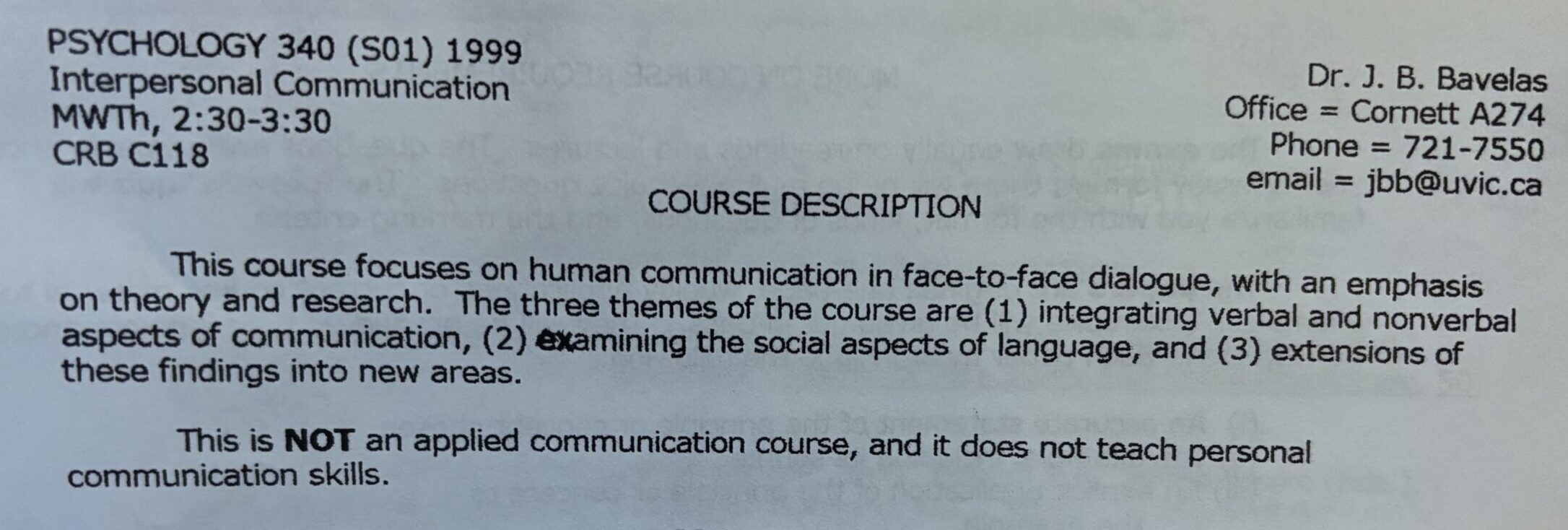
Psych 340- Interpersonal Communication
Jan opened up a new world for me: everyday conversations came alive! She filled her course with examples of video-recorded dialogues to demonstrate what we were learning. The ethos was respectful, full of lively argumentation and critical thinking. Instead of a textbook, she assigned published articles and chapters. In weekly “papers”, she directed us to recognize a concept defined that week (e.g., irony, gesture, metaphor) in our own experience that week. To get a full grade on the paper, we had to argue point-by-point that what we witnessed fit the specifics of the definition. I loved the disciplined curiosity she fostered and the way she taught us to pay attention to conversation in a new way.
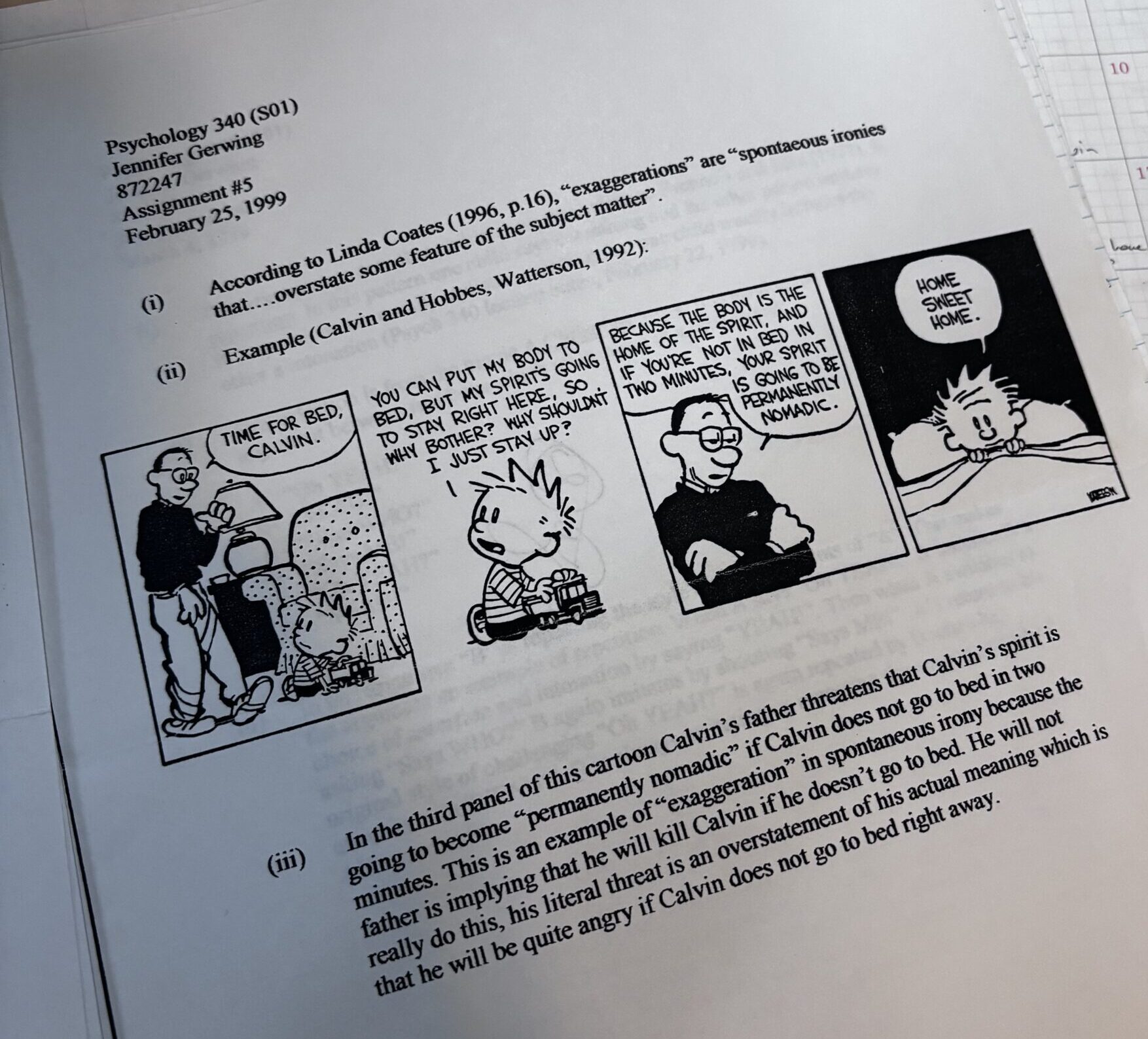
My week #5 paper about exaggeration
I asked if I could work as a research assistant for Jan during the summer of 1999. I guess I couldn’t get enough, because I also asked her to supervise my master’s and PhD work. In fact, I worked with her and her team of research assistants and graduate students until her passing, in 2022.
Bench learning
In my early years in Jan’s research team, we were knee deep in a couple gesture projects. My master’s project involved video recording people manipulating toys (because why not make it fun?) and then discussing them with each other. We varied whether they talked to someone who played with the same toys or not, in order to see whether common ground about the toys that the participants shared influenced the gestures they used to refer to them (Gerwing and Bavelas, 2004).
Jan Bavelas was a firm believer in what one could call bench learning. We got absorbed into projects (or thrown in the deep end, which is how it felt sometimes) and learned how to do things along the way. We ran and assessed the pilot studies and formal experiments, did the necessary inductive work, sorted through issues at weekly meetings, figured out the logical way to construct an analysis that would test our hypotheses. We sometimes would work for a while in one direction before deciding it wasn’t working, then would go back to the drawing board. It was never quick and easy work.
What I realized much later was that this kind of learning by doing is often tacit. The microanalytic process was the water we were swimming in, but there was little need to articulate and disentangle the multiple threads of reasoning behind our choices.
Supervision
Post PhD, I started working in Norway and entered the world of medical emergency calls and later clinical interactions between patients and their physicians. I was fortunate enough to be working with practitioners and researchers who were committed to doing research that was both informed by and relevant to their work.
In the last years, I have been supervising others to use microanalysis for their projects using clinical dialogues (e.g., medical, social work), and I discovered the challenges of transforming bench learning into concrete, practical guidance that others can use to work independently.
Communities of practice
I have lately had the enriching experience of being a part of two communities of practice (the Ahus microanalysis workshop and the Skabersjö microanalysis group).
With my supervisory experience and these communities, I have seen the variety of ways people use microanalysis. Beyond some essentials, there’s a huge range of individualization and creativity from start to finish. Every result section of an article ends up being a unique expression of the researcher who led the project.
In the summer of 2025, I decided that a website could be a way to draw together resources, advice, and experiences to support those who are curious about using microanalysis.